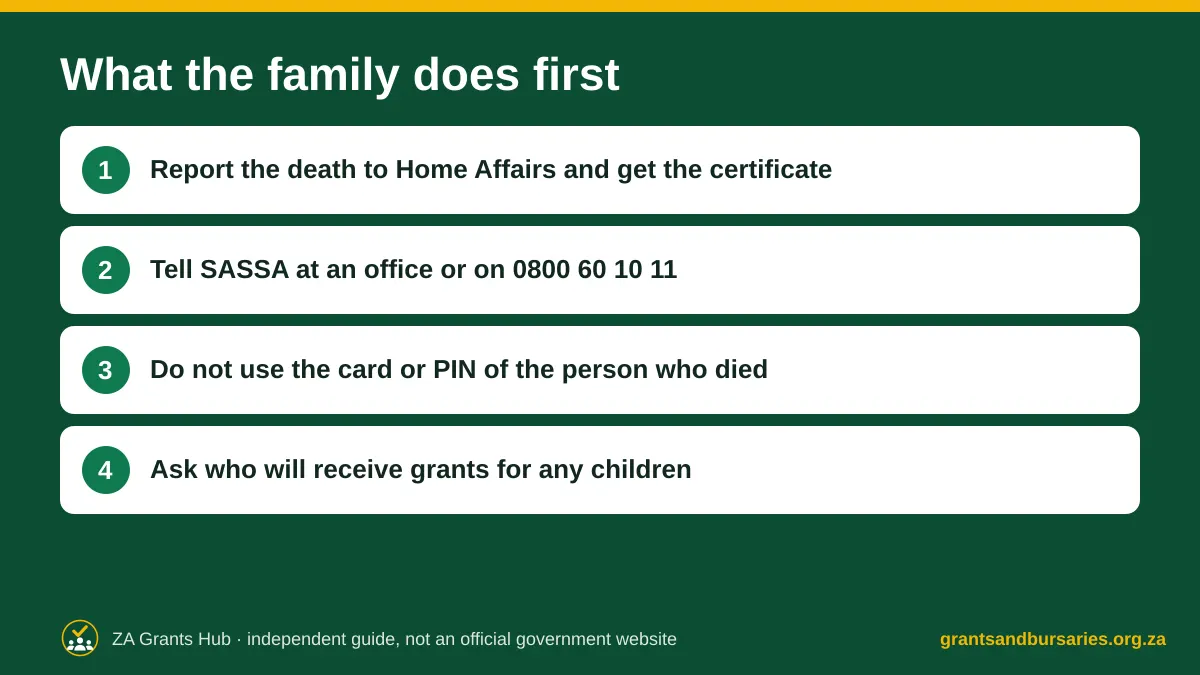
To report the death of a SASSA beneficiary, first report the death to Home Affairs, then tell SASSA at a local office or on 0800 60 10 11. The grant is payable up to the last day of the month of death. Next of kin may apply for unclaimed money within six months. Do not use the person's card or PIN.
Contents (14 topics)
- How do you report the death of a SASSA beneficiary?
- Where do you register the death first?
- Which documents should you take to SASSA?
- What happens to the grant after death?
- Can the family claim money still owed?
- What if a payment arrives after the person died?
- What about children who depended on the person?
- What if the person had a procurator or grant-in-aid?
- What if the person received the SRD R370 grant?
- What if SASSA says a living person is dead?
- What if the report does not get resolved?
- Tips for families dealing with a grant after a death
- Frequently Asked Questions
- Your best next step
How do you report the death of a SASSA beneficiary?
Tell SASSA directly, even if you have already registered the death. An office visit with documents gives you the clearest record.
- Report the death to Home Affairs. Keep the notification and the death certificate.
- Gather the papers. Take the person's ID, your ID and anything showing their grant.
- Contact SASSA. Visit a local office, phone 0800 60 10 11 or email [email protected].
- Give the facts. State the name, ID number and date of death to the official.
- Ask about money. Check what was paid and what is still due for the month of death.
- Raise the children. Say if the person received grants for any child.
- Record the reference. Write down the number, the date and the official's name.
Use our SASSA offices guide to find a branch. Our Contact page lists other ways to reach the agency.
Where do you register the death first?
Report the death to Home Affairs. The gov.za death certificate page says a death may also be reported to:
- Police members, especially where there is no Home Affairs office.
- Recognised funeral undertakers.
- A South African mission abroad, if the death happened outside the country.
Home Affairs issues the death certificate once it receives the notification. Ask for more than one certified copy, because banks, insurers and SASSA may each want one. Do this as soon as possible. A funeral parlour can often help with the notification.
Which documents should you take to SASSA?
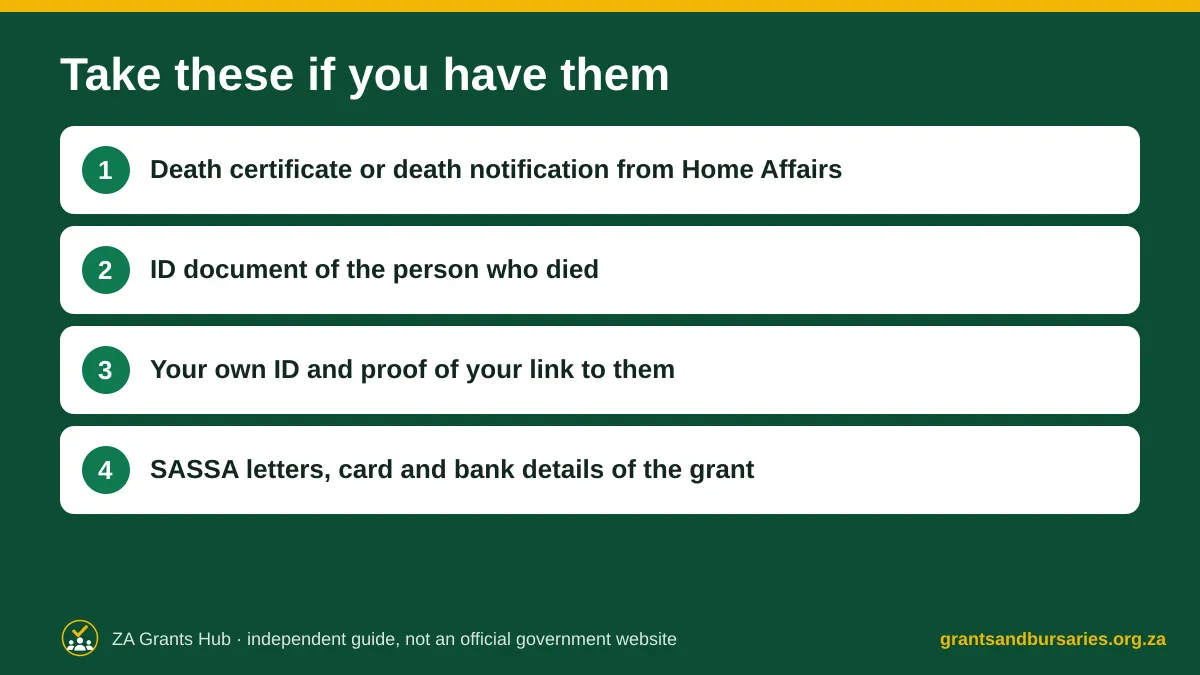
Take the death certificate and both IDs as a start. SASSA may ask for more, depending on the grant and your claim.
| Document | Why it helps | If you do not have it |
|---|---|---|
| Death certificate | Proves the death and date | Take the notification of death and ask SASSA |
| ID of the person who died | Finds the right record | Give any copy or ID number you have |
| Your ID | Shows who is reporting | Ask what other identification SASSA accepts |
| Proof of your relationship | Supports a next of kin claim | An affidavit may help; ask first |
| SASSA letters, card or SMS | Shows the grant type | Say which grant you believe they received |
Do not delay your report just because one paper is missing. Report first and add documents later.
What happens to the grant after death?
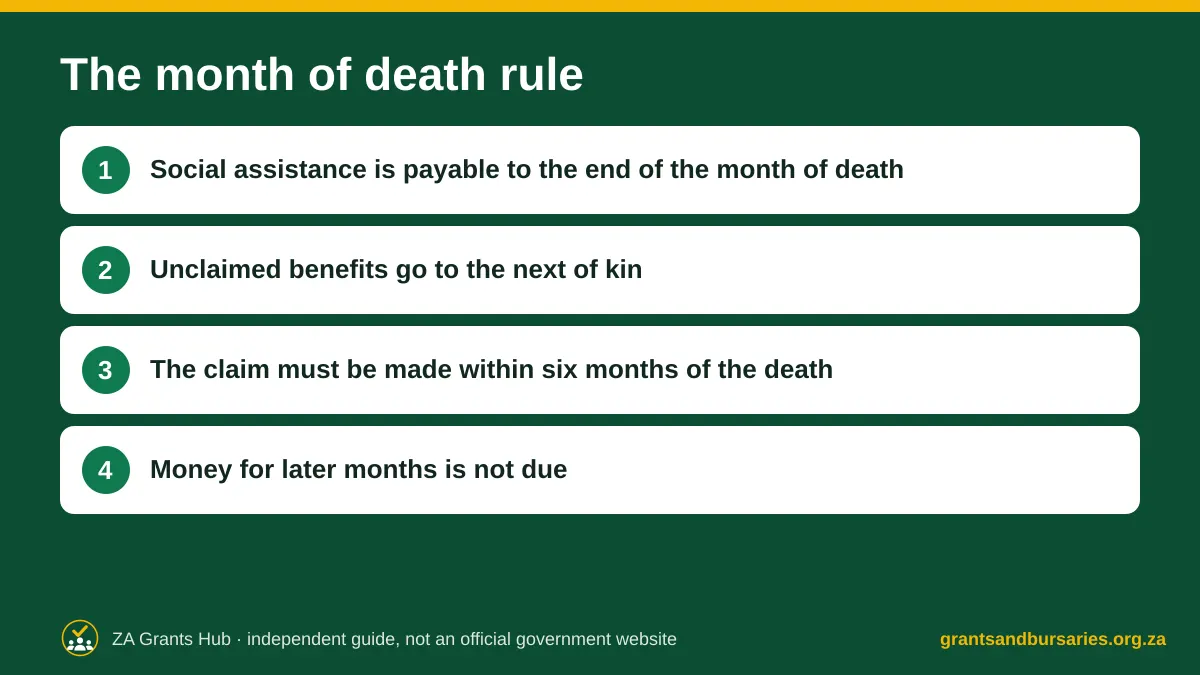
The grant ends, but not before the month of death is complete. Regulation 38 says social assistance is payable until the last day of the month in which the beneficiary or child dies.
The lapsing rules vary slightly by grant:
| Grant | When the regulations say it lapses |
|---|---|
| Older person, disability or war veteran's grant | Last day of the month in which the beneficiary dies |
| Child support grant | End of the month in which the child dies |
| Care dependency grant | Last day of the month in which the child dies |
| Foster child grant | Month in which the child dies, or the last living foster parent dies |
A grant for a living child is treated differently when only the caregiver dies. See the section on children below.
Can the family claim money still owed?
Yes, next of kin can apply for unclaimed benefits. The application must be made within six months after the death.
This covers money that was due up to the end of the month of death and was not claimed. It does not give the family further monthly payments.
- Ask SASSA whether anything is unpaid.
- Ask for the form or process for next of kin.
- Submit the death certificate, your ID and proof of the relationship.
- Keep your receipt and note the date.
- Follow up before the six months run out.
Warning: Do not draw money with the card or PIN of a person who died, even if you paid for the funeral. Ask SASSA for the lawful claim route.
What if a payment arrives after the person died?
Do not spend money meant for months after the death. Tell SASSA and ask what to do with it.
Money can still arrive if records were not updated before the payment run. The Act says an amount paid to someone who was not entitled to it is owed to the State. That debt can also fall on a deceased person's estate.
Keep the bank statement. Note the date and amount. Ask SASSA for written instructions before moving the money. Our Overpayment guide explains how recovery works.
What about children who depended on the person?
Raise this at your first visit, so the child is not left without support. The Act says that when a procurator or primary caregiver dies, SASSA must appoint a person to receive the grant without suspending it. Conditions apply.
In practice, the person now caring for the child should apply at a SASSA office. Take the child's birth certificate, your ID, the death certificate and proof that the child lives with you.
If both parents have died and you are a relative, ask about the Child support grant top-up. Our guide on When the child grant stops covers the caregiver's death in more detail. A court placement may point to the Foster child grant.
What if the person had a procurator or grant-in-aid?
Tell the procurator that the authority to collect must not be used for later months. Ask SASSA to record the death against the appointment.
If the person who died was the procurator, the beneficiary is still entitled to the grant. They need a new arrangement. Read about Appointing a procurator.
A grant-in-aid is linked to an adult grant, so mention it when you report. If the person who died was the helper, tell SASSA how the beneficiary is now cared for.
What if the person received the SRD R370 grant?
Report the death to Home Affairs and tell SASSA as well. SASSA may pick up the death from government records, but do not rely on that.
Ask SASSA whether anything is due for the month of death and how next of kin may claim it. Do not log in with the person's phone to change banking details. That can look like fraud.
What if SASSA says a living person is dead?
That is a record error, and it needs Home Affairs and SASSA. Visit Home Affairs with your ID to correct the population register. Then take proof of the correction to SASSA.
Our guide to Proof of life and "deceased" errors gives the full route. Ask about missed months once your record is fixed.
What if the report does not get resolved?
Return with your reference number and ask for a written update. Then escalate in this order.
- Ask for the office manager.
- Email [email protected] with the reference, without any PINs.
- Phone 0800 60 10 11 and request a new reference.
- Follow our Complaint steps.
If you suspect someone is still drawing the money, report it on the National Anti-Corruption Hotline, 0800 701 701.
Tips for families dealing with a grant after a death
These small steps protect you from debt and delay.
- Report early. Early notice reduces the chance of money being paid for later months.
- Make copies. Certify several copies of the death certificate at once.
- Choose one contact. Let one family member deal with SASSA and keep the file.
- Keep statements. Save bank statements that show deposits around the date of death.
- Count six months. Put the claim deadline in your phone or calendar.
- Mention every grant. Include child, care dependency and grant-in-aid payments.
- Guard the card. Do not hand it to relatives or lenders; ask SASSA what to do with it.
- Ignore callers. Hang up on anyone who asks for a fee or PIN to release money.
Frequently Asked Questions
How do I report the death of a SASSA beneficiary?
Report the death to Home Affairs, then tell SASSA at a local office, on 0800 60 10 11 or by email to [email protected]. Take the death certificate, the person's ID and your own ID. Ask for a reference number and mention any grants the person received for children.
Does SASSA pay for the month in which a person dies?
Yes. Regulation 38 says social assistance is payable until the last day of the month in which a beneficiary or child dies. If that money was not claimed, next of kin may apply for it. The application must be made within six months of the death, so ask SASSA early.
How long do I have to claim unpaid grant money?
The regulations give next of kin six months after the death to apply for unclaimed benefits. Do not wait until the last weeks, because you may need extra documents. Ask SASSA for the form, hand in your proof and keep a receipt that shows the date you applied.
Is there a SASSA funeral grant?
We found no SASSA funeral grant in the grant booklet or regulations. Families may receive unclaimed benefits owed up to the end of the month of death, which is a different thing. If the person had a funeral policy, contact the insurer. Be wary of anyone selling a "SASSA funeral payout".
Can I use the card to buy food after the death?
No. Using the card or PIN of a person who has died can create a debt and may lead to criminal action. Money due for the month of death should be claimed through SASSA. If your household is in urgent need, ask a SASSA office about other help, including social relief.
What if nobody has a death certificate yet?
Still tell SASSA that the person has died and say the certificate is on the way. Take the notification of death or any paper from the hospital, police or undertaker. Then return with the certificate. Ask Home Affairs what is delaying it and keep a note of your visit.
Who gets the child grant when the mother dies?
The person who now takes primary care of the child can apply. The grant follows the child's care and is not inherited. Take the child's birth certificate, your ID, the death certificate and proof that you care for the child. SASSA decides if more than one person claims that role.
Do I report a death that happened outside South Africa?
Yes. Report it to the South African mission in that country, which gov.za lists for deaths abroad. Then inform SASSA with the documents you receive. Foreign certificates may need extra steps before they are accepted, so ask Home Affairs and SASSA what they require.
Will SASSA already know from Home Affairs?
It may learn of the death from government records, but you should not rely on that. A delay in registering or updating the death could let payments continue. Telling SASSA yourself creates a dated record that you acted in good faith. It also lets you ask about unpaid money and about any children.
Can a neighbour or friend report the death?
Yes, anyone who knows of the death can alert SASSA. A claim for unpaid benefits is different, because it is for next of kin. A friend should take what details they have and leave the claim to family. Reports of misuse can also go to 0800 701 701.
Your best next step
Take the death certificate and both IDs to your nearest SASSA office. Report the death, ask about unpaid money and raise any child's grant in the same visit.
Sources
- Social Assistance Regulations, 31 May 2022 (Government Notice R2119)
- Social Assistance Act 13 of 2004
- Gov.za: Death certificate
- SASSA booklet: You and Your Grant 2026

About The Author
Sarah Johnson is an informational writer covering South African social assistance programmes, SASSA grants and public service updates.
Keep Reading