The child support grant stops at the end of the month in which the child turns 18. It can also end earlier, for example if the child dies or leaves your care. A caregiver's death does not end the child's need, so the new caregiver should apply at SASSA quickly. The grant is R580 a month in 2026.

Contents (14 topics)
- When does the child support grant stop?
- What else can stop the grant early?
- Does the grant stop if your child misses school?
- Can a higher income end the grant?
- What happens to the grant when the caregiver dies?
- How does a new caregiver apply?
- What if both parents have died?
- What happens when your child turns 18?
- What if the grant stopped before the child turned 18?
- What if two people claim the same child?
- Where do you get help?
- Tips for avoiding a surprise stop
- Frequently Asked Questions
- Your next step
When does the child support grant stop?
It normally stops after the month of the child's 18th birthday. You should still receive the payment for the birthday month.
| Child turns 18 in | Last month due | No payment from |
|---|---|---|
| January 2027 | January 2027 | February 2027 |
| April 2027 | April 2027 | May 2027 |
| August 2027 | August 2027 | September 2027 |
| December 2027 | December 2027 | January 2028 |
The date of the birthday inside the month does not change this. A child born on the first and a child born on the last day lapse at the same month end.
Matric does not extend it. A learner who turns 18 in Grade 11 or 12 still reaches the age limit.
What else can stop the grant early?
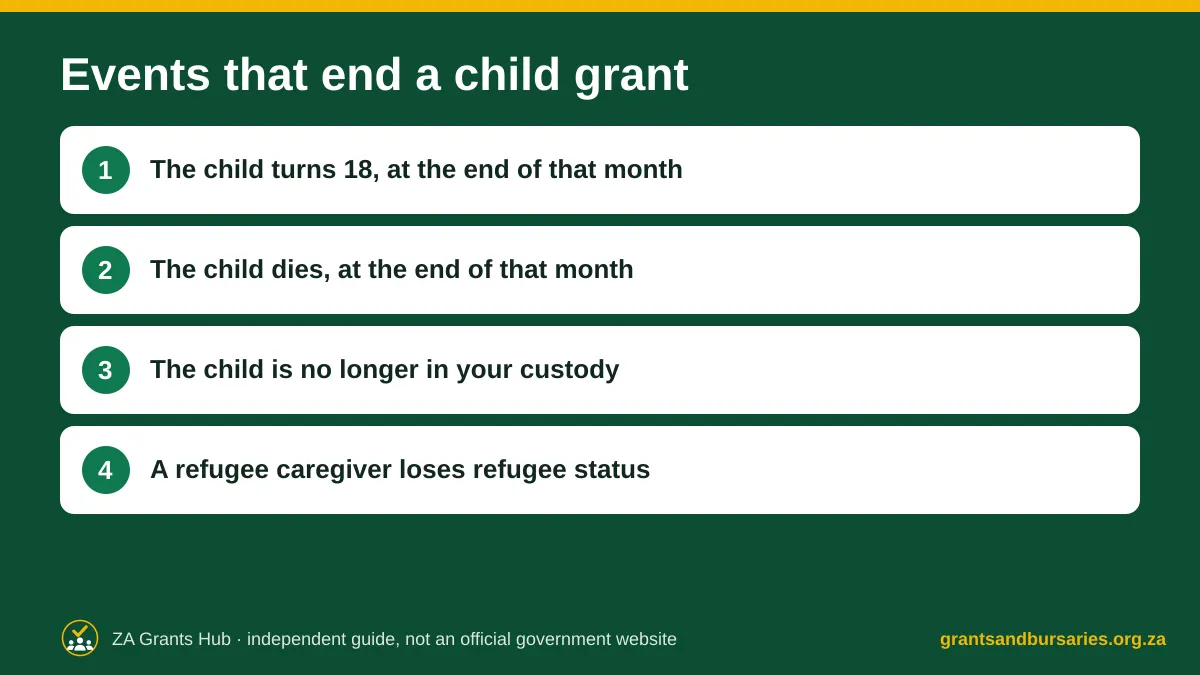
Several events can end or pause payment before age 18. Each one has a different fix.
| Event | What it means | Your first move |
|---|---|---|
| Child dies | Lapses at the end of that month | Report the death |
| Child leaves your custody | The grant is no longer yours to receive | Tell SASSA |
| Child is cared for in a state-funded institution | The child no longer meets the rules | Report the admission |
| Your income rises above the limit | You may no longer qualify | Declare it |
| Review not completed | Payment can be suspended | Attend with your documents |
| Not claimed for three months in a row | Payment can be suspended | Apply for restoration |
| More than 90 days outside South Africa | Payment can stop | Tell SASSA before leaving |
| Fraud or approval in error | SASSA can suspend or cancel | Respond to the notice |
A child grant also lapses if a refugee caregiver stops being a refugee. For the wider reporting duty, see Changes you must report to SASSA.
Does the grant stop if your child misses school?
Caregivers must make sure a child aged 7 to 18 is enrolled and attends school. SASSA's 2026 booklet says failure to attend or to send proof will not lead to a refusal of the grant.
The regulations do require proof of enrolment and attendance within one month of approval for a school-age child. If a child is out of school, the Department of Social Development can be asked to investigate. Send the school letter when SASSA asks for it.
Can a higher income end the grant?
Yes. The grant has a means test, and the regulations say it continues until age 18 or until the caregiver's income status changes.
Report a new job, a pay rise or a marriage that changes household income. SASSA assesses the case before it decides. Our Means test guide explains how income is measured. Do not guess the limit from old web pages; ask SASSA for the current figure.
What happens to the grant when the caregiver dies?
The old caregiver's authority to receive it ends, but the child can still be supported. The Social Assistance Act says SASSA must appoint a person to receive the grant for the child without suspending it, subject to conditions.
The regulations also say a primary caregiver's role runs until another takes over, or until the caregiver's death. In practice, the person now looking after the child should go to SASSA and apply.
Warning: Do not keep drawing the money with the card of a caregiver who died. Apply in your own name and ask SASSA what to do with any payment already received.
Who can become the new primary caregiver?
The person who actually takes primary responsibility for the child. This may be a surviving parent, grandparent, aunt, uncle, older sibling or another adult.
If more than one person claims the role, SASSA weighs the facts and chooses one. A person who is not the biological or adoptive parent may receive the grant for no more than six children. Someone employed to look after the child does not qualify.
How does a new caregiver apply?
Apply in person at a SASSA office as soon as you can.
- Get the death certificate from Home Affairs.
- Collect the child's birth certificate and any school or clinic records.
- Take your own ID and your spouse's ID if you are married.
- Prove that you care for the child. An affidavit from a police official or a social worker's report can help.
- Add income papers, such as payslips and three months of bank statements.
- Complete the application with the SASSA official.
- Keep the receipt and note the date you applied.
SASSA has up to three months to tell you the outcome. If approved, the grant is generally paid from the date of application. Delay therefore costs money.
Report the old caregiver's death at the same time. Our guide on Reporting the death of a beneficiary covers unpaid money.
What if both parents have died?
A relative who cares for the child may qualify for an extra amount on top of the grant. The gazetted top-up is R290, which makes R870 with the R580 grant.
You need death certificates for both parents, or one certificate and an affidavit about the other parent. See the full Child grant top-up guide. If a court places the child with you, ask about the Foster child grant instead.
What happens when your child turns 18?
The payment ends after that month, and you do not need to cancel it. Plan for the gap before it happens.
- A young adult aged 18 or older can check whether they qualify for the SRD grant.
- A learner can look at NSFAS funding and bursaries for further study.
- A young person with a lasting disability can apply for a Disability grant.
- A care dependency grant also ends at 18, so apply for the adult grant in good time.
None of these is automatic. Each needs its own application.
Do foster and care dependency grants stop at the same time?
No. A foster child grant generally lapses at the end of the calendar year in which the child turns 18. It can continue in some study cases, up to the year of the 21st birthday. A care dependency grant ends after the month of the 18th birthday.
What if the grant stopped before the child turned 18?
Find the reason first, then fix that reason.
- Check for SMS messages and letters from SASSA.
- Phone 0800 60 10 11 or visit an office and ask why payment stopped.
- Confirm the child's date of birth on SASSA's record.
- Check your bank account and card.
- Take proof that answers the reason given.
- Apply for restoration within 30 days if the grant was suspended for review or non-collection.
- Ask about an appeal if you disagree with a decision.
Read how to Restore a suspended grant. If the money was released but never arrived, see Banking pending or payment failed.
What if two people claim the same child?
SASSA decides who the primary caregiver is. The regulations say it must consider all the relevant factors before choosing one person.
Bring evidence of daily care, not only of your family link. Useful items include school letters that name you, clinic records and a social worker's report. Do not share a card or swap payments privately, because that arrangement can collapse without warning.
If the child splits time between homes, explain the real pattern honestly. A social worker or legal advice office can help families agree before one person applies.
Where do you get help?
Start with SASSA at an office, on 0800 60 10 11 or at [email protected]. A social worker can help with care disputes. A legal advice office can help when a decision looks wrong.
Check dates on our Child support grant payment date page before assuming a payment is missing. Our Child support grant guide explains who qualifies.
Tips for avoiding a surprise stop
Plan ahead and keep your records tidy.
- Mark the month. Write each child's 18th birthday month on your calendar.
- Budget early. Start planning for the lost R580 several months before.
- Update your number. SASSA messages must reach you.
- Keep school proof. File each year's school letter.
- Open every notice. Review and suspension messages often have deadlines.
- Collect on time. Do not leave payments unclaimed for months.
- Name a backup. Tell a trusted relative where the child's documents are.
- Declare income changes. A report now is safer than a debt later.
- Check each child. One child ageing out should not affect the others; confirm the new total.
Frequently Asked Questions
When does child support grant stop?
It stops at the end of the month in which the child turns 18. That month is normally still paid. It can end sooner if the child dies, leaves your custody or you no longer qualify. SASSA can also suspend payment after a missed review or for other reasons set out in the rules.
Does the grant continue if my child is still at school at 18?
No. The child support grant ends at age 18, even if the child has not finished matric. This differs from the foster child grant, which can run longer for study in some cases. Your 18-year-old can look at other options, such as the SRD grant or study funding.
Do I need to cancel the grant when my child turns 18?
The grant lapses on its own under the regulations, so there is no usual cancellation step. Check that the amount drops correctly after the birthday month. If money for that child still arrives later, tell SASSA and do not treat it as yours, because it may have to be repaid.
What happens to the grant if the mother dies?
The person who now cares for the child should apply at SASSA with the death certificate, the child's birth certificate and their own ID. The Act provides for someone to receive the grant without suspension, subject to conditions. Do not use the mother's card. Report the death at the same visit.
Can a grandmother get the child support grant?
Yes, if she is the child's primary caregiver and meets the means test and other rules. She should take proof that the child lives with her and that she provides the care. If both parents have died, she can also ask about the top-up for relatives caring for orphans.
Will the grant stop if the child moves to the father?
The caregiver who no longer has custody should tell SASSA, because the grant lapses when the child leaves that person's custody. The father may apply if he is now the primary caregiver and qualifies. If you disagree about who cares for the child, SASSA can weigh the facts.
Can I get money back if the grant stopped by mistake?
Ask SASSA to check the record and to pay any months that were wrongly missed. Take proof of the child's age, custody and your visits. Back payment is not automatic and depends on why payment stopped. If SASSA refuses, ask for written reasons and the appeal process.
How long does a new caregiver wait for approval?
The regulations give SASSA three months from the application date to notify you of the outcome. Many cases need extra documents, so respond quickly. Payment is generally backdated to the date of application when approved. Keep your receipt and phone 0800 60 10 11 to follow up if you hear nothing.
Does the grant stop if I travel abroad?
A long absence can stop payment. If you plan to be outside South Africa for more than 90 days, tell SASSA before you go. The rules for children also require the child to be cared for properly. Ask SASSA how your travel plans affect your own case before leaving.
What is the child grant amount before it stops?
The child support grant is R580 per child each month, according to the March 2026 gazette notice, effective from April 2026. Relatives who qualify for the orphan top-up receive a further R290. Amounts usually change through official announcements, so confirm the current figure with SASSA.
Your next step
Check the birth month of every child on your grant today. If a caregiver has died or a payment stopped early, take the papers to SASSA this week and keep the receipt.
Sources
- Social Assistance Regulations, 31 May 2022 (Government Notice R2119)
- Social Assistance Act 13 of 2004
- Gov.za: Child support grant
- SASSA booklet: You and Your Grant 2026
- Government Notice R7287: increase in social grants, 23 March 2026

About The Author
Sarah Johnson is an informational writer covering South African social assistance programmes, SASSA grants and public service updates.
Keep Reading