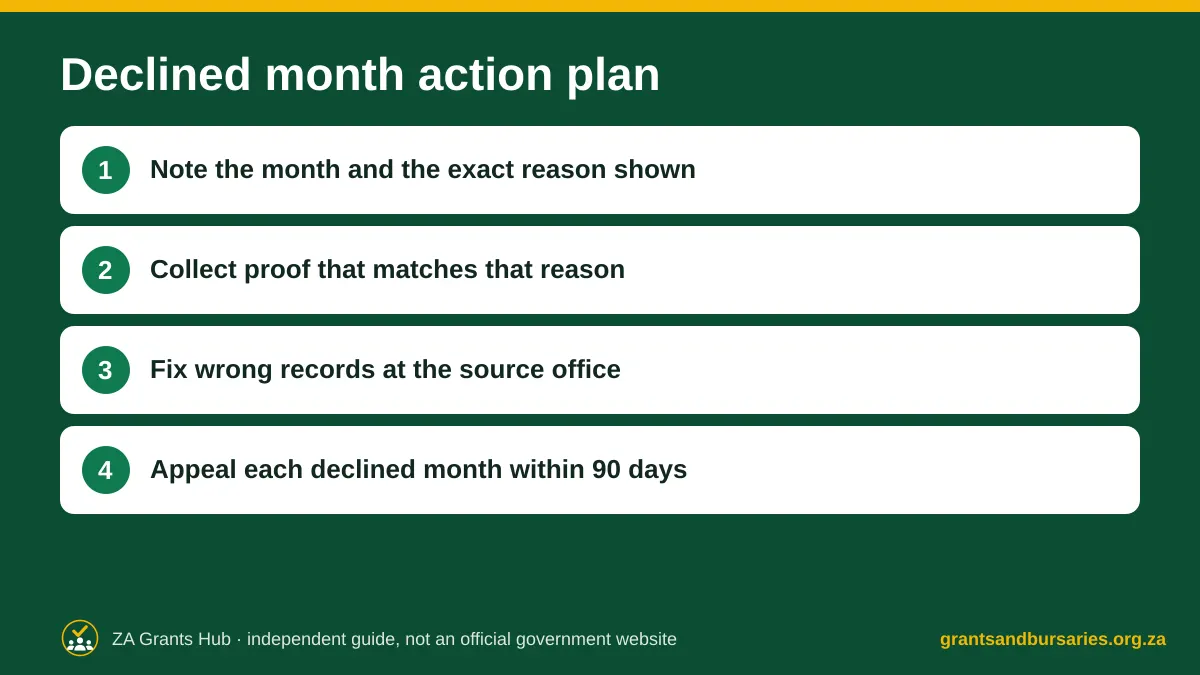
A SASSA status declined result means SASSA did not approve the SRD grant for the month shown. Read the reason beside it, collect proof that answers that reason, and appeal that month within 90 days. A decline for one month does not close your application for every month.
Contents (19 topics)
- What does SASSA status declined mean?
- Who can qualify for the SRD grant?
- What are the common SASSA decline reasons?
- How do you check why SASSA declined you?
- How do you fix an alternative income source decline?
- How do you fix an identity verification decline?
- How do you fix a UIF registered or NSFAS registered decline?
- What does an existing grant or duplicate decline mean?
- What if SASSA records you as deceased?
- How do you appeal a declined SASSA status?
- What proof should you gather for an appeal?
- How should you write your appeal explanation?
- What if the appeal site is not working?
- What should you avoid after a decline?
- How long does an SRD appeal take, and what comes after?
- Why did your status change from approved to declined?
- Tips for dealing with a declined SASSA status
- Frequently Asked Questions
- Your best next step
What does SASSA status declined mean?
Declined means SASSA tested your application for that month and decided you did not meet a condition. The status usually shows a short reason.
SASSA checks the R370 SRD grant again every month. That is why one month can be approved and the next declined. A decline is a decision about a period, not a lifelong ban.
The decision often comes from an automated match against other databases. SASSA has told Parliament that it treats those results as reflecting what the source institutions hold. If a source record is wrong, you need to correct it at that source too.
Declined also differs from pending. Pending has no decision yet. See our Pending status guide if your screen still says that.

Who can qualify for the SRD grant?
You need to meet every condition, not only the one in your decline reason. Check this list before you spend time on an appeal.
- You are a South African citizen, permanent resident or recognised refugee, or hold a qualifying permit or visa.
- Asylum seekers need a valid section 22 permit or visa.
- You are 18 or older and below 60.
- You live in South Africa.
- You have insufficient means. SASSA lists the monthly means test as R624.
- You do not receive another social grant for yourself.
- You are not cared for in a state-funded institution.
- You do not unreasonably refuse work or study opportunities.
The income rules are the subject of a court case. The High Court ruled against several SRD rules in January 2025. Government appealed, and the Supreme Court of Appeal heard the matter in August 2026. Check official news for the outcome, because the threshold could change.
What are the common SASSA decline reasons?
Most declines fall into a few groups: income, another database record, identity, another grant or a duplicate record. Find your wording in the table.
| Reason shown | What it usually points to | First thing to do |
|---|---|---|
| Alternative income source identified | Money seen that suggests you are above the means test | Pull bank statements for that month |
| Identity verification failed | Your details could not be confirmed | Verify, and check Home Affairs records |
| UIF registered | A match on the UIF database | Ask the UIF what it holds |
| NSFAS registered | A match on student funding records | Get your NSFAS status in writing |
| Existing grant identified | A social grant in your own name | Confirm which grant and whether it stopped |
| Duplicate application | More than one record linked to you | Stop reapplying and contact SASSA |
| Recorded as deceased | A death record against your ID | Go to Home Affairs first |
The exact words on your result may differ. Use the reason SASSA shows you, not a guess from social media.
How common are database declines?
Database matches are only part of the picture. A July 2026 parliamentary reply counted declines up to 1 April 2026. It listed 262,991 on UIF checks, 25,265 on NSFAS checks and 119,427 on other database outcomes. The same reply put all declines at more than 9.1 million. SASSA linked many problems to income matches in source data.
How do you check why SASSA declined you?
Open the official status page and read each month separately. You need your ID number and the phone number you applied with.
- Go to srd.sassa.gov.za.
- Open the status check.
- Enter your details.
- Find each declined month and copy the reason word for word.
- Take a screenshot that shows the month and the date.
You can also use the USSD code **\*134\*7737# or the SRD WhatsApp number 082 046 8553**. Our SRD status check guide compares the options.
Warning: SASSA does not ask for your bank PIN. Do not share one with anyone who offers to "reverse" a decline.
How do you fix an alternative income source decline?
Compare your bank statements with the declined month and identify every deposit. Then appeal with proof if the money was not income that counts against you.
Check all accounts in your name, including old ones and mobile money wallets. Look for salary, casual work, regular support from others, transfers between your own accounts and one-off gifts.
Write a short list: date, amount, who sent it and why. Attach what supports it. A loan repayment or money you held for someone else is easier to explain with their written statement. SASSA or the Tribunal may still count it, so do not treat any explanation as a guarantee.
Our Income verification guide goes through eWallet money and own-account transfers in detail.

How do you fix an identity verification decline?
Confirm that your details match Home Affairs, then complete the verification that SASSA asks for. Spelling, ID number or date of birth differences can stop a match.
- Compare your application details with your ID.
- Request a verification link on the SRD portal if one is offered.
- Complete the face check in good light.
- If it keeps failing, visit a SASSA office for help.
- If Home Affairs holds wrong details, correct them there. Call 0800 60 11 90.
Read more about the face check in our Biometric verification guide. The page on SRD identity verification failures covers that message.
How do you fix a UIF registered or NSFAS registered decline?
Ask the source institution what it holds against your ID, then use its answer as your appeal evidence.
UIF record
Contact the UIF call centre on 0800 030 007 or visit a Labour Centre. Ask whether you receive a benefit, qualify for one, or are still listed as employed. An old employer may not have reported that you left. Our UIF decline guide has the full steps.
NSFAS record
Check your account with NSFAS and ask for written proof of your funding status. SRD rules treat NSFAS student funding as disqualifying support. If your funding ended or you were never funded, say so in your appeal and attach the proof. Start with How to check your NSFAS status.
If you are still funded for that month, an appeal is unlikely to help. You may be able to qualify in a later month after the funding stops.
What does an existing grant or duplicate decline mean?
An existing grant decline means SASSA found a social grant paid to you personally. A duplicate decline means your record appears more than once.
Existing grant
A disability grant or older person's grant in your own name blocks SRD. A Child Support Grant that you receive for a child is paid for the child's care. If SASSA declined you only for that, ask SASSA to explain and consider appealing. If a grant has stopped, get written proof.
Duplicate application
Do not submit another application. Call 0800 60 10 11 or visit an office. Say which phone numbers you have used. If you believe someone used your ID, tell SASSA, report it on the fraud line 0800 701 701 and consider opening a police case.
What if SASSA records you as deceased?
Go to Home Affairs before you do anything with SASSA, because SASSA relies on the population register. An appeal cannot repair a wrong death record.
Take your ID and ask Home Affairs to investigate your life status. Keep the proof that the record was corrected. Then follow up with SASSA and appeal the affected months. Our Proof of life and deceased status guide explains the order.
How do you appeal a declined SASSA status?
Lodge an online appeal with the Independent Tribunal for Social Assistance Appeals within 90 days of the monthly outcome. Appeal every declined month separately.
- Open the SRD appeals platform from srd.sassa.gov.za/appeals or srd.dsd.gov.za.
- Enter your ID number and confirm the one-time PIN sent to your phone.
- Choose the month you want to appeal.
- Pick the reason that matches your case.
- Explain the facts in short, clear sentences.
- Submit, then save the confirmation.
- Repeat for each other declined month.
The appeals page also mentions a 30-day point inside the 90-day limit. Do not wait. Lodge your appeal as early as you can.
Warning: the Tribunal decides each month on its own. Appealing March does not cover April.
The full walkthrough is in How to appeal an SRD decision.

What proof should you gather for an appeal?
Choose documents that answer the stated reason and cover the declined month. Extra papers about other issues do not help.
| Decline reason | Useful proof |
|---|---|
| Income | Statements for that month, notes on each deposit, proof a job ended |
| UIF | UIF or Labour Centre confirmation, employer termination letter |
| NSFAS | NSFAS status letter or screenshot, proof studies or funding ended |
| Identity | Clear copy of ID, Home Affairs correction proof |
| Existing grant | Letter or SMS showing the grant stopped |
| Deceased record | Home Affairs proof that your status was corrected |
Keep originals at home and keep a copy of whatever you submit. Some rules limit new evidence at appeal stage, so give complete and truthful information from the start.
How should you write your appeal explanation?
State the facts in date order and answer the decline reason directly. A clear, short account is easier to follow than a long complaint.
Use three parts. First, say which month you are appealing and what SASSA wrote. Second, say why that is wrong, with dates. Third, list the proof you hold.
Here are two patterns to adapt. Change every detail to match the truth.
- Income: "I am appealing June. The deposit on 12 June was my own money moved from my other account. Both statements show it."
- UIF: "I am appealing June. I did not receive UIF that month. My job ended in March, and I have asked the UIF for confirmation."
Do not write that you have no income if you earned money. A false statement can harm your case and later months.
What if the appeal site is not working?
Try again soon, use another device, and keep proof that you tried. Do not leave it until the last day of your 90 days.
| Problem | What to try |
|---|---|
| No one-time PIN arrives | Check signal and message storage, then request it again |
| The phone number is old | Update your number through the official SRD process or call SASSA |
| The page does not load | Try later, another browser or another network |
| The month cannot be selected | Check whether an appeal already exists or the window has passed |
| You have no smartphone or data | Ask for help at a SASSA office |
Keep screenshots of errors with the date and time. Then call 0800 60 10 11 or email [email protected]. Give your name, the month and the error you saw. Send ID details only through official channels.
If your number has changed, follow the guide to Changing your SRD phone number before you try again.
What should you avoid after a decline?
Avoid anything that adds confusion to your record or puts your money at risk.
- Do not create a second application under another number.
- Do not change banking details to try to "reset" the result.
- Do not buy a "decline removal" service.
- Do not send ID photos or PINs to people on social media.
- Do not edit or alter bank statements. Fraud can lead to prosecution and recovery of money.
- Do not ignore later months while you wait for one appeal.
Check your status every month, even while an appeal is open. A new decline starts a new appeal window.
How long does an SRD appeal take, and what comes after?
SASSA's appeals page says the Tribunal aims to finish within 60 to 90 days of receiving your appeal. Real waits can differ.
Check progress on the same appeals platform. Our Appeal outcome guide explains the results you may see.
If the appeal succeeds, the month should move to approved and then be paid. If it fails, the Tribunal's decision is final inside the system. A court review under administrative justice law is the remaining route. Free help may be available from legal aid or advice offices.
Why did your status change from approved to declined?
Your circumstances or the records about you may show something different in the new month. SASSA tests eligibility again each time.
Typical triggers include a new deposit, a job record, a UIF payment, student funding, or an identity flag. Read the reason for the new month. Your earlier approval does not protect later months.
A cancelled status is not the same as declined. If you see it, read What SRD status cancelled means.
Tips for dealing with a declined SASSA status
- Copy the exact reason. Your appeal should answer those words. A general complaint is weaker.
- Count your 90 days. Mark the deadline on a calendar for every declined month.
- Fix the source too. Correct UIF, NSFAS or Home Affairs records, or the same decline can return.
- Check all your accounts. An old account you forgot may hold the deposit SASSA saw.
- Tell the truth. Hiding income can lead to recovery of money paid to you.
- Do not open new applications. Duplicates create another problem on top of the first.
- Save proof of submission. Screenshot the confirmation and write down the date.
- Keep your number active. SASSA and the appeals system send PINs and notices to it.
- Refuse paid "agents". Appeals are free. Nobody can sell a guaranteed approval.
Frequently Asked Questions
Why is my SASSA status declined?
SASSA found something that failed an SRD condition for that month. Common causes include income above the means test, a UIF or NSFAS match, identity problems, another grant, or a duplicate record. Your status result shows the reason. Read it for each declined month, because different months can carry different reasons.
Can a declined SASSA status change to approved?
Yes, in two ways. A successful appeal can overturn a declined month. A later month can also be approved if your circumstances or records change. Neither happens automatically for the declined month, so you must appeal it within 90 days if you believe SASSA decided it wrongly.
How long do I have to appeal a declined SRD month?
You have up to 90 days from the monthly outcome. The appeals page also refers to a 30-day point within that window, so lodge early. Each declined month has its own clock and its own appeal. Save the confirmation that appears after you submit each one.
Where do I appeal a declined SASSA status?
Use the online SRD appeals platform, reached through srd.sassa.gov.za/appeals or srd.dsd.gov.za. The Independent Tribunal for Social Assistance Appeals decides the case. You need your ID number and the phone that receives your one-time PIN. If you cannot go online, ask a SASSA office to help you.
Do I need to reapply after a decline?
Not usually. A decline applies to a month, and your application can be assessed again in later months. Do not create a duplicate application. Check the portal for any reapplication instruction on your record, and update your details if your phone number or banking information has changed since you applied.
What if I never registered for UIF but got declined for it?
Ask the UIF or a Labour Centre what record exists under your ID number. An employer may have registered you, or an old job may still show as active. Get the answer in writing, ask for corrections, and attach that proof to your appeal for every affected month.
Does money from family cause a decline?
It can. The means test looks at income and financial support, and bank checks may pick up deposits. The definition is part of a pending court case. List each deposit honestly, explain who sent it and why, and attach proof. An explanation does not guarantee that the appeal will succeed.
Will I get back pay if my appeal succeeds?
A successful appeal relates to the month you appealed, so payment for that month should follow once the record updates. It does not automatically repair other declined months. Make sure your banking details are correct and verified. Check the status page afterwards for an approval and a pay date.
Can I appeal and fix my records at the same time?
Yes, and it is often sensible. Lodge the appeal early so you do not miss the deadline. At the same time, ask Home Affairs, the UIF or NSFAS to correct wrong information. Keep every confirmation, because it helps with the appeal and protects future months.
Who can help me if I cannot understand the reason?
Call SASSA toll-free on 0800 60 10 11 or email [email protected]. You can also visit a local SASSA office with your ID and a screenshot of the status. Ask the official to explain the reason and the month. Help is free, and you should never give anyone your bank PIN.
Your best next step
Open your status, write down each declined month with its reason, and lodge the appeal for the oldest month today while you gather proof. Then correct the source record behind it. If the wording is unfamiliar, check our Status meanings page.
Sources
- Parliamentary reply NW3195 on SRD declines and appeals (PMG)
- SRD status guide (SASSA)
- SRD appeals page
- You and Your Grant 2026 booklet (SASSA)
- SASSA clarifies review of social grants (gov.za)

About The Author
Sarah Johnson is an informational writer covering South African social assistance programmes, SASSA grants and public service updates.
Keep Reading